

If you run a yoga studio, pilates studio, wellness practice, or any service-based business, this episode is your permission slip to hear some hard truths — and walk away with a real, low-investment marketing strategy you can actually use.
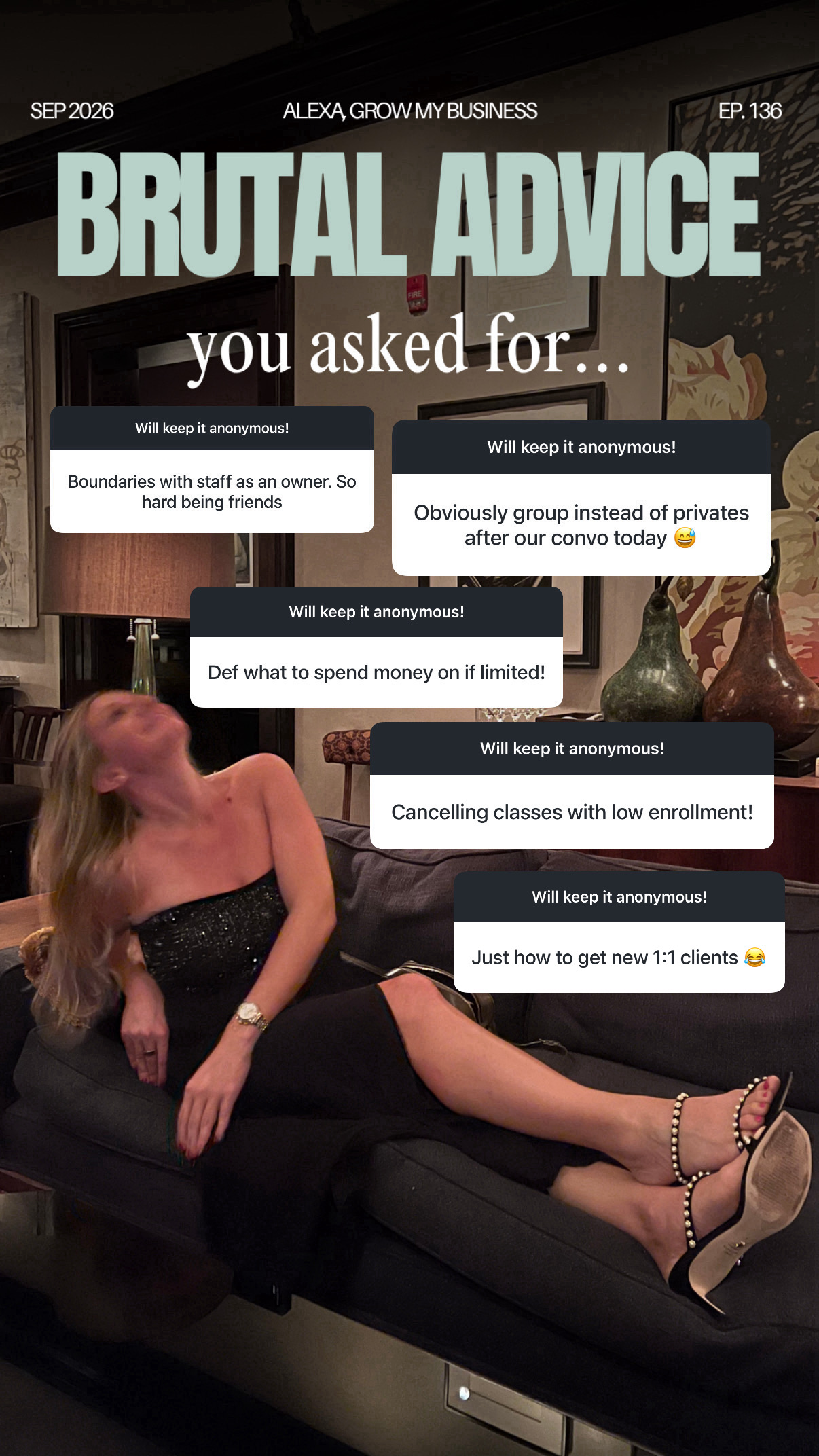
I sat down solo this week to get honest about the stuff most business owners avoid talking about: burnout language in your marketing, where your money should actually go, how to land more 1:1 clients, whether to add a class or a private, and the boundary conversations every studio owner dreads with staff.
Why “I’m Tired, Just Buy My Thing” Needs to Disappear From Your Marketing
There’s a trend going around where business owners post some version of “I’m tired of making content, please just buy my thing.” I’m asking you, please, don’t post this.
Running a business is a choice we made — full stop. Positioning your business as a burden to your clients is a slippery slope, and it works against everything good marketing is supposed to do. The way we actually get clients is by showing why we know our stuff, why we’re trustworthy, and why we get results. That’s the foundation of organic marketing for wellness business owners: education first, always.
Pay for Saved Time (It’s Not a Splurge, It’s Math)
Piecing together your own marketing — emails, social plans, website design — costs you more than time. It costs you brain space that should be spent doing the one thing only you can do: working your magic with your clients.
This is exactly why I built The Friday Society Membership with done-for-you social prompts, email templates, and worksheets already built in. Less time creating from scratch means more energy for the work that actually makes you money.
What to Spend Money on When You’re Limited
If your budget is tight, prioritize these three things:
- Automation software that saves you time and runs your business in the background (I recommend Flodesk, Zapier, and Momence).
- Done-for-you marketing strategy — social plans, templates, and a plan you don’t have to build from scratch.
- An environment that inspires you — a coffee shop or coworking space is one of the cheapest, most overlooked investments you can make.
And the free bonus tip? Brain.fm or binaural beats for focus. Here’s the one I personally use.
How to Get More 1:1 Clients
This is one of the questions I get most, and my answer always comes back to the same three pillars:
Educational content. Whether it’s a podcast, an email list, Substack, or Instagram — pick the platform that feels authentic and easy to you, and educate with zero expectation that anyone buys anything. That’s how trust gets built, and that’s how 1:1 clients find you.
Strategic partnerships. Connect with businesses your ideal client is already using. Booking software, a neighborhood coffee or smoothie shop — go where your people already are.
SEO — the free, unsexy, non-negotiable one. This is where SEO for small business owners becomes a genuine growth lever, because it costs you nothing but time. The basics: identify your key phrases (what you want people to Google to find you), repurpose your long captions and newsletters into blog posts instead of letting that content disappear, and don’t skip your SEO title, description, and image alt-text — most people never touch these, and it’s the difference between showing up in search or not. Verifying your domain in Google Search Console is another free move that boosts visibility and keeps your emails out of spam.
I walk through this entire framework — plus the exact homework I give my members — inside The Friday Society Membership’s SEO module.
Class or Private? The Abundance vs. Scarcity Answer
If group classes are what your business is known for, add the class — not the private. A private is scarcity thinking: guaranteed income, but no ripple effect. A full class is abundance thinking: it fills, it builds community, and every person in that room becomes a potential referral. If you’ve got the capacity, growth comes from staying visible, not retreating into private sessions.
Boundaries With Staff When They’re Also Your Friends
This one’s hard, and I get it. My advice starts with communication ground rules:
- DMs = fun, little asides — not for business conversations, since they’re too easy to miss.
- Texts = personal life only. Redirect anything business-related to email.
- Email = all the business things — questions, reschedules, everything official.
Beyond communication, remember: your nervous system dictates your business performance. You cannot run a thriving business from a place of overwhelm, and that shows up fastest in how staff meetings feel. Protecting white space in your schedule — even one non-client day, or two half-days for admin — changes everything.
Books I recommend for becoming a more grounded leader: Radical Candor by Kim Scott, Focal Point by Brian Tracy, and the Real Conversations Framework from Lululemon.
Want to Go Deeper?
Everything in this episode — the SEO framework, the done-for-you social plans, a community to process the hard stuff with — is inside The Friday Society Membership. And if staff boundaries are hitting close to home, Jennifer Maanavi from Physique 57 is joining us inside TFS in November to talk through exactly this.


Be the first to comment